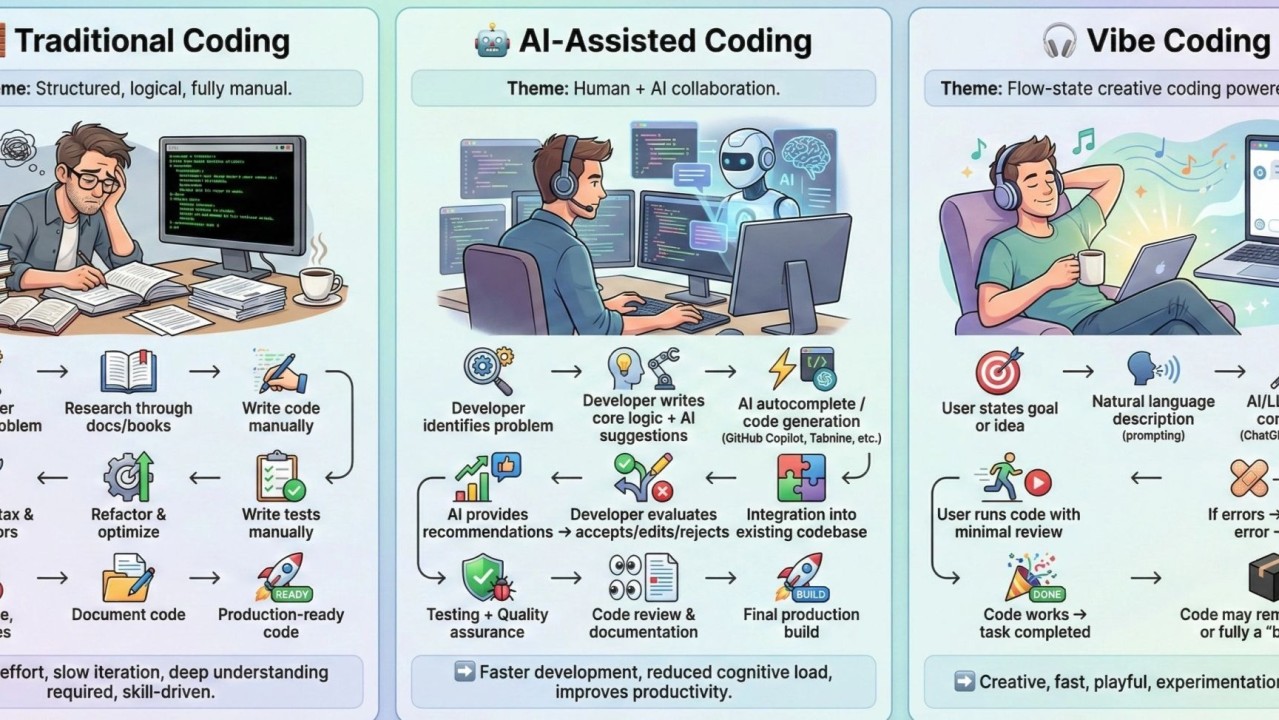
Something has shifted in how software gets written. As an engineer, I’ve noticed that I no longer work in a single mode throughout the day. Depending on the task, the stakes, and the context, I switch between three fundamentally different headspaces — and recognising which one to be in has become as important as any technical skill.
Mode 1: Traditional Coding
Traditional coding is manual, deliberate, and total-control. You write every line, reason through every decision, and understand the full implications of the code you produce.
There is a deep satisfaction in knowing you understand every single line. When something breaks, you know where to look. When a colleague asks why something works a certain way, you can explain it fully.
This mode is slower — but it builds the deepest understanding. It’s where you learn. It’s where complex, business-critical, or security-sensitive code should live.
Best for:
- Core domain logic
- Security-critical code paths
- Novel problems with no clear prior art
- Situations where you need to deeply understand what you’re building
Mode 2: AI-Assisted Coding
AI-assisted coding is my default mode today. It’s a constant collaboration — I handle the logic, intent, and architectural decisions, while AI tools manage boilerplate, suggest implementations, and reduce cognitive overhead.
The workflow feels like pair programming with a very fast, very well-read partner who sometimes hallucinates. You stay in control of the wheel, but the journey is significantly faster.
This mode reduces friction without reducing understanding. I still review every line. I still reason about every decision. But I spend less time on the mechanical aspects of writing code and more time on what matters.
Best for:
- Most day-to-day development tasks
- Boilerplate and scaffolding
- Translating well-understood patterns into code
- Code reviews and refactoring suggestions
Mode 3: Vibe Coding
Vibe coding is the newest mode — and the most misunderstood. It’s about describing ideas in plain language and iterating on results rather than syntax. You’re directing, not writing.
The speed advantage is real. For prototyping, exploration, and proof-of-concept work, vibe coding collapses the feedback loop dramatically. You can test ten ideas in the time it would traditionally take to implement one.
But vibe coding doesn’t eliminate the need for strong engineering fundamentals — it requires them. You need to evaluate what gets generated, spot the subtle bugs, recognise the architectural shortcuts that will cause problems at scale. Without a strong foundation, vibe coding produces fast-moving, difficult-to-maintain code.
Best for:
- Rapid prototyping and exploration
- Proof-of-concept development
- Low-stakes internal tools
- Learning new domains quickly
The Real Skill: Knowing Which Mode to Use
The most important insight isn’t about any single mode — it’s about switching between them deliberately.
A day of engineering now might look like: vibe coding to explore a new API (Mode 3), shifting to AI-assisted coding to build the actual integration (Mode 2), and dropping into traditional coding for the authentication and error-handling logic (Mode 1).
Conflating these modes is where things go wrong. Vibe coding your security layer is dangerous. Traditionally coding your boilerplate is inefficient. AI-assisted coding without review is irresponsible.
What This Means for Engineers
The spectrum of coding modes is expanding — and that’s a good thing. More tools, more leverage, more ways to deliver value.
But the fundamentals don’t go away. Understanding algorithms, systems, trade-offs, and failure modes matters more as the code generation layer becomes more automated. The engineer who can work across all three modes — and knows when to use each — is more valuable than ever.
The headspace is different. The skill is knowing which one you’re in.