Software delivery loses information at every handoff. An idea starts out clear in someone’s head, goes through six meetings, three Confluence pages and a Jira backlog nobody reads, and ends up as code that solves last quarter’s version of the problem. Even good teams lose time and detail at each boundary between product, architecture, development and QA.
Over the last few months I’ve been building something to attack this: SDLC Factory. It takes a plain-English product idea and drives it through a full delivery pipeline using 10 specialised AI agents, enforced artifact contracts between stages, and human approval gates at the points that matter.
It’s more than a chatbot wrapper. It has parallel development threads, a QA auto-fix loop, context compression for long conversations, prompt injection scanning, multi-tenant isolation and a cost tracker. This post covers how I built it, the design decisions that mattered, and what I got wrong the first time.
What’s wrong with the usual approaches
Most AI coding agents I’ve seen fall into one of two camps:
- Single-agent loops. One model does everything: requirements, design, code and tests. It forgets what it decided three pages ago and writes code that doesn’t match its own spec.
- Unstructured multi-agent systems. Agents spawn sub-agents freely and coordinate in natural language. It sounds powerful, but in my experience the coordination overhead eats the gains and debugging is painful.
Neither guarantees that the output of one stage is valid input for the next. Requirements drift from the architecture, and the architecture drifts from the code. There’s no contract.
SDLC Factory enforces one. Every stage produces a JSON artifact validated against a schema, and the next stage gets only what it needs from earlier stages. It never sees the raw conversation history.
System architecture
Here’s how the whole system fits together:
%%{init: {'theme': 'dark', 'themeVariables': {'primaryColor': '#313244', 'primaryTextColor': '#CDD6F4', 'primaryBorderColor': '#89B4FA', 'lineColor': '#A6ADC8', 'secondaryColor': '#1E1E2E', 'background': '#1E1E2E', 'mainBkg': '#313244', 'clusterBkg': '#24243E', 'clusterBorder': '#45475A', 'titleColor': '#CDD6F4', 'edgeLabelBackground': '#1E1E2E', 'fontFamily': 'JetBrains Mono, monospace', 'fontSize': '13px'}}}%%
flowchart TB
    classDef entry  fill:#1A3A2A,stroke:#A6E3A1,color:#A6E3A1
    classDef orch   fill:#1A2A3A,stroke:#89B4FA,color:#89B4FA
    classDef agent  fill:#2A1A3A,stroke:#CBA6F7,color:#CBA6F7
    classDef tool   fill:#3A2A1A,stroke:#FAB387,color:#FAB387
    classDef mem    fill:#3A1A2A,stroke:#F38BA8,color:#F38BA8
    classDef db     fill:#2A3A1A,stroke:#A6E3A1,color:#A6E3A1
    classDef gw     fill:#1A3A3A,stroke:#94E2D5,color:#94E2D5
    classDef tel    fill:#3A3A1A,stroke:#F9E2AF,color:#F9E2AF

    subgraph Entry["Entry Points"]
        CLI["CLI · sdlc.py"]:::entry
        API["Web API · FastAPI"]:::entry
        WH["Webhook · HITL callback"]:::entry
        QUE["Programmatic · ApprovalQueue"]:::entry
    end

    subgraph Orch["Pipeline Orchestrator  core/pipeline.py"]
        SM["Stage machine · artifact routing\ngate evaluation · checkpoint/resume\nasync disk writer"]:::orch
    end

    subgraph AgentL["Agent Layer  agents/"]
        BASE["BaseSDLCAgent subclasses per role\nSKILL.md system prompt · scoped toolset\nartifact producer · iteration budget"]:::agent
    end

    subgraph Runtime["Agent Runtime  core/agent_runtime.py"]
        LOOP["Model call loop · tool dispatch\ncontext compression · OTel spans"]:::orch
    end

    subgraph Tools["Tool Pipeline  tools/"]
        TR["Self-registering modules\nTTL-cached availability checks\nfile · terminal · pytest · docker · github · kanban"]:::tool
    end

    subgraph Mem["Shared Memory  core/memory.py"]
        PM["Tier 1: ProjectMemory\nTier 2: ArtifactBundle\nTier 3: Kanban Blackboard\nStreamingContextScrubber\nPrompt injection scanner"]:::mem
    end

    subgraph DB["Persistence  core/session.py — SQLite WAL"]
        TABLES["pipeline_runs · stage_artifacts · audit_log\nkanban_tasks · kanban_events · artifact_fts FTS5"]:::db
    end

    subgraph GW["HITL Gateway  gateway/hitl.py"]
        MODES["cli · auto · slack · webhook · queue\nApprovalQueue · audit record"]:::gw
    end

    subgraph Tel["Telemetry  core/telemetry.py"]
        OT["OpenTelemetry spans\nno-op fallback · JSON structured logs"]:::tel
    end

    Entry --> Orch
    Orch  --> AgentL
    AgentL --> Runtime
    Runtime --> Tools
    Runtime --> Mem
    Mem --> DB
    Orch --> GW
    Runtime --> Tel
Each layer has one job, and no layer talks to a non-adjacent one.
Seven Stages, Ten Agents
The pipeline runs seven sequential stages, with HITL gates after the four highest-stakes decisions:
%%{init: {'theme': 'dark', 'themeVariables': {'primaryColor': '#313244', 'primaryTextColor': '#CDD6F4', 'primaryBorderColor': '#89B4FA', 'lineColor': '#A6ADC8', 'secondaryColor': '#1E1E2E', 'background': '#1E1E2E', 'mainBkg': '#313244', 'clusterBkg': '#24243E', 'clusterBorder': '#45475A', 'titleColor': '#CDD6F4', 'edgeLabelBackground': '#1E1E2E', 'fontFamily': 'JetBrains Mono, monospace', 'fontSize': '13px'}}}%%
flowchart TD
    classDef stage  fill:#313244,stroke:#89B4FA,color:#CDD6F4
    classDef gate   fill:#3A1A2A,stroke:#F38BA8,color:#F38BA8
    classDef done   fill:#1A3A2A,stroke:#A6E3A1,color:#A6E3A1
    classDef start  fill:#1A2A3A,stroke:#89B4FA,color:#89B4FA

    I([" Idea "]):::start --> D0

    subgraph D0["Stage 0 · Discovery"]
        DE["Domain Expert\n+ Product Owner"]:::stage
    end
    subgraph D1["Stage 1 · Requirements"]
        BA["Business Analyst"]:::stage
    end
    subgraph D2["Stage 2 · Architecture"]
        AR["Architect"]:::stage
    end
    subgraph D3["Stage 3 · Planning"]
        TL["Tech Lead"]:::stage
    end
    subgraph D4["Stage 4 · Development  ⟨parallel⟩"]
        BK["Backend Dev"]:::stage
        UI["UI Dev"]:::stage
        DO["DevOps Dev"]:::stage
    end
    subgraph D5["Stage 5 · Quality Gate"]
        QA["QA Engineer"]:::stage
    end
    subgraph D6["Stage 6 · Delivery"]
        RM["Release Manager"]:::stage
    end

    D0 --> D1
    D1 --> G1[/"HITL Gate"/]:::gate
    G1 -->|APPROVED| D2
    D2 --> G2[/"HITL Gate"/]:::gate
    G2 -->|APPROVED| D3
    D3 --> D4
    D4 --> D5
    D5 --> G3[/"HITL Gate"/]:::gate
    G3 -->|APPROVED| D6
    D6 --> G4[/"HITL Gate"/]:::gate
    G4 -->|APPROVED| DONE(["Completed"]):::done
The 10 roles map onto these stages. Each is a thin subclass of BaseSDLCAgent with a fixed output schema:
# core/pipeline.py
SDLC_STAGES = [
    StageDefinition("discovery",    ["domain_expert", "product_owner"]),
    StageDefinition("requirements", ["business_analyst"],         hitl_gate=True),
    StageDefinition("architecture", ["architect"],                hitl_gate=True),
    StageDefinition("planning",     ["tech_lead"]),
    StageDefinition("development",  ["developer_backend", "developer_ui", "developer_devops"],
                    parallel=True),
    StageDefinition("quality_gate", ["qa_engineer"],             hitl_gate=True),
    StageDefinition("delivery",     ["release_manager"],          hitl_gate=True),
]
The Agent Contract
The agent hierarchy is the core abstraction. Every role declares exactly what it needs, what tools it can use, and what it must produce:
%%{init: {'theme': 'dark', 'themeVariables': {'primaryColor': '#313244', 'primaryTextColor': '#CDD6F4', 'primaryBorderColor': '#89B4FA', 'lineColor': '#A6ADC8', 'secondaryColor': '#1E1E2E', 'background': '#1E1E2E', 'mainBkg': '#313244', 'clusterBkg': '#24243E', 'clusterBorder': '#45475A', 'titleColor': '#CDD6F4', 'edgeLabelBackground': '#1E1E2E', 'fontFamily': 'JetBrains Mono, monospace', 'fontSize': '13px'}}}%%
classDiagram
    class BaseSDLCAgent {
        +ROLE str
        +OUTPUT_SCHEMA dict
        +ENABLED_TOOLSETS list
        +run(idea, bundle, run_id)
        +prior_stages() list
        -_run_loop(system_prompt, messages, budget)
        -skill_md() str
    }

    class DomainExpertAgent {
        +tools: web_search, read_file, memory
    }
    class ProductOwnerAgent {
        +tools: read_file, memory, write_file
    }
    class BusinessAnalystAgent {
        +tools: read_file, memory, write_file
    }
    class ArchitectAgent {
        +tools: read_file, web_search, write_file
    }
    class TechLeadAgent {
        +tools: read_file, write_file, kanban_create
    }
    class DeveloperBackendAgent {
        +tools: full_stack
    }
    class DeveloperUIAgent {
        +tools: full_stack, browser
    }
    class DeveloperDevOpsAgent {
        +tools: full_stack, terminal
    }
    class QAEngineerAgent {
        +tools: read_file, terminal, execute_code
    }
    class ReleaseManagerAgent {
        +tools: read_file, write_file, terminal
    }

    BaseSDLCAgent <|-- DomainExpertAgent
    BaseSDLCAgent <|-- ProductOwnerAgent
    BaseSDLCAgent <|-- BusinessAnalystAgent
    BaseSDLCAgent <|-- ArchitectAgent
    BaseSDLCAgent <|-- TechLeadAgent
    BaseSDLCAgent <|-- DeveloperBackendAgent
    BaseSDLCAgent <|-- DeveloperUIAgent
    BaseSDLCAgent <|-- DeveloperDevOpsAgent
    BaseSDLCAgent <|-- QAEngineerAgent
    BaseSDLCAgent <|-- ReleaseManagerAgent
Every subclass declares:
OUTPUT_SCHEMA, JSON Schema that the runtime validates the artifact against before advancingENABLED_TOOLSETS, scoped tool access (read-only roles like Architect can’t callterminal)prior_stages(), which prior artifacts get injected into this agent’s context
prior_stages() matters most here. The Architect sees the glossary and business requirements but not the Product Owner’s raw conversation, so there’s less noise for it to build on.
class ArchitectAgent(BaseSDLCAgent):
    ROLE = "architect"
    ENABLED_TOOLSETS = {"read_file", "write_file", "skill_list", "skill_view"}
    OUTPUT_SCHEMA = {
        "type": "object",
        "required": ["adrs", "component_diagram", "tech_stack"],
        "properties": {
            "adrs": {
                "type": "array",
                "items": {"type": "object", "required": ["id", "title", "context", "decision", "consequences"]}
            },
            "tech_stack": {"type": "object", "required": ["backend", "frontend", "database", "infra"]}
        }
    }

    def prior_stages(self):
        return ["discovery", "requirements"]
Three-Tier Memory System
Rather than dumping everything into one context window, the pipeline uses three tiers of memory so each agent gets the right context:
%%{init: {'theme': 'dark', 'themeVariables': {'primaryColor': '#313244', 'primaryTextColor': '#CDD6F4', 'primaryBorderColor': '#89B4FA', 'lineColor': '#A6ADC8', 'secondaryColor': '#1E1E2E', 'background': '#1E1E2E', 'mainBkg': '#313244', 'clusterBkg': '#24243E', 'clusterBorder': '#45475A', 'titleColor': '#CDD6F4', 'edgeLabelBackground': '#1E1E2E', 'fontFamily': 'JetBrains Mono, monospace', 'fontSize': '13px'}}}%%
graph LR
    classDef t1 fill:#1A3A2A,stroke:#A6E3A1,color:#A6E3A1
    classDef t2 fill:#1A2A3A,stroke:#89B4FA,color:#89B4FA
    classDef t3 fill:#2A1A3A,stroke:#CBA6F7,color:#CBA6F7
    classDef ag fill:#313244,stroke:#A6ADC8,color:#CDD6F4

    subgraph T1["Tier 1 — Project Glossary"]
        PM["PROJECT_MEMORY.md\nWritten by Domain Expert once\nInjected into ALL agent system prompts\nShared vocabulary, bounded contexts"]:::t1
    end

    subgraph T2["Tier 2 — Stage Artifacts"]
        AB["SQLite stage_artifacts\nPer-stage validated JSON\nEach agent receives only prior_stages()"]:::t2
        SC["StreamingContextScrubber\nStrips fence tags from output\nin real time"]:::t2
        AB --> SC
    end

    subgraph T3["Tier 3 — Kanban Blackboard"]
        KB["kanban_tasks + kanban_events\nEphemeral per run\nDev agents post task state\nParent dispatcher reads board"]:::t3
    end

    T1 -->|system prompt| AG([" Agents "]):::ag
    T2 -->|context block| AG
    T3 -->|task metadata| AG
Tier 1, Project Memory (PROJECT_MEMORY.md): Written by the Domain Expert on the first turn. Contains the shared glossary, bounded contexts, and project conventions. Injected into every agent’s system prompt, verbatim. This is the shared language of the project.
Tier 2, Artifact Bundle (SQLite + in-memory): Each completed stage writes a validated JSON artifact. Agents receive only the stages listed in their prior_stages() declaration, injected as <stage-context> fence blocks. A StreamingContextScrubber strips these tags from the model’s output in real-time to prevent the agent from echoing context blocks back.
Tier 3, Kanban Blackboard (SQLite): Used by parallel development agents to coordinate without sharing message histories. Developers post task state transitions (ready → in_progress → done) and JSON comments. The parent dispatcher reads the board; individual agents never see each other’s prompts.
The Parallel Development Stage
The development stage fans out three agents concurrently in a ThreadPoolExecutor:
%%{init: {'theme': 'dark', 'themeVariables': {'primaryColor': '#313244', 'primaryTextColor': '#CDD6F4', 'primaryBorderColor': '#89B4FA', 'lineColor': '#A6ADC8', 'secondaryColor': '#1E1E2E', 'background': '#1E1E2E', 'mainBkg': '#313244', 'clusterBkg': '#24243E', 'clusterBorder': '#45475A', 'titleColor': '#CDD6F4', 'edgeLabelBackground': '#1E1E2E', 'fontFamily': 'JetBrains Mono, monospace', 'fontSize': '13px'}}}%%
flowchart TD
    classDef lead  fill:#1A3A3A,stroke:#94E2D5,color:#94E2D5
    classDef pool  fill:#313244,stroke:#A6ADC8,color:#CDD6F4
    classDef dev   fill:#1A2A3A,stroke:#89B4FA,color:#89B4FA
    classDef qa    fill:#2A1A3A,stroke:#CBA6F7,color:#CBA6F7
    classDef kb    fill:#3A2A1A,stroke:#FAB387,color:#FAB387

    TL["TechLeadAgent\nCreates task cards in planning stage"]:::lead -->|populates| KB[(Kanban Board\nSQLite)]:::kb

    KB --> POOL["ThreadPoolExecutor\nmax_workers = max_concurrent_developers"]:::pool

    POOL --> B["DeveloperBackendAgent\nAPI task cards · Thread 1\nscoped to src/task_id/"]:::dev
    POOL --> U["DeveloperUIAgent\nUI task cards · Thread 2\nscoped to src/task_id/"]:::dev
    POOL --> D["DeveloperDevOpsAgent\nIaC task card · Thread 3\nscoped to src/task_id/"]:::dev

    B -->|kanban_complete| KB
    U -->|kanban_complete| KB
    D -->|kanban_complete| KB

    B --> JOIN["All threads joined\nDevelopment artifact merged"]:::pool
    U --> JOIN
    D --> JOIN

    JOIN --> QA["QAEngineerAgent\nblocked until all devs done"]:::qa
Each developer thread:
- Gets a fresh message history, zero cross-agent context leak
- Is scoped to
output/<run_id>/src/<task_id>/with path traversal protection - Coordinates only via kanban task state, no direct inter-agent communication
- Has
clarify,send_message, anddelegate_tasktools blocked, no recursive sub-agent spawning
# core/pipeline.py
with ThreadPoolExecutor(max_workers=4) as pool:
    futures = {
        pool.submit(agent.run, workspace, db_session): agent
        for agent in dev_agents
    }
    for future in as_completed(futures):
        artifacts.append(future.result())
The first version had all three developers writing to a shared directory. They clobbered each other’s files within the first test run. Path-scoped namespacing was the obvious fix in retrospect.
The QA Auto-Fix Loop
When QA fails, most pipelines stop and wait for a human. That’s right for some failures, but many are simple to fix in one pass: a missing import, a mismatched API signature, a forgotten migration. The QA loop handles those automatically:
%%{init: {'theme': 'dark', 'themeVariables': {'primaryColor': '#313244', 'primaryTextColor': '#CDD6F4', 'primaryBorderColor': '#89B4FA', 'lineColor': '#A6ADC8', 'secondaryColor': '#1E1E2E', 'background': '#1E1E2E', 'mainBkg': '#313244', 'clusterBkg': '#24243E', 'clusterBorder': '#45475A', 'titleColor': '#CDD6F4', 'edgeLabelBackground': '#1E1E2E', 'fontFamily': 'JetBrains Mono, monospace', 'fontSize': '13px'}}}%%
flowchart TD
    classDef qa    fill:#2A1A3A,stroke:#CBA6F7,color:#CBA6F7
    classDef dev   fill:#1A2A3A,stroke:#89B4FA,color:#89B4FA
    classDef gate  fill:#3A1A2A,stroke:#F38BA8,color:#F38BA8
    classDef done  fill:#1A3A2A,stroke:#A6E3A1,color:#A6E3A1

    QA["QA Engineer\nruns full test suite"]:::qa --> CHK{"All pass?"}

    CHK -->|yes| ADV["Advance pipeline"]:::done

    CHK -->|no| GRP["Group failing tests\nby owning developer task"]:::dev
    GRP --> FIX["Re-dispatch original\ndeveloper agent per group"]:::dev
    FIX --> RE["QA re-runs"]:::qa
    RE --> ITER{"Iteration ≤ 3?"}

    ITER -->|yes| CHK
    ITER -->|no| ESC["escalated_to_hitl = true\nPause for human review"]:::gate
The key is “group by owning developer task.” Each developer wrote code under their namespace. When those tests fail, the fix goes back to that developer, not to a generic fix agent that doesn’t know the codebase structure.
# core/qa_loop.py
class QALoop:
    def run(self, qa_agent, dev_agents, workspace, db):
        for iteration in range(self.max_iterations):
            report = qa_agent.run(workspace, db)
            if report["gate_passed"]:
                return report
            failing_by_task = self._group_failures(report["failing_tests"])
            for task_id, failures in failing_by_task.items():
                dev = self._find_owner(task_id, dev_agents)
                dev.fix(failures, workspace, db)
        report["escalated_to_hitl"] = True
        return report
Three iterations has covered almost everything I’ve tested. If it needs a fourth, it’s usually a design problem, and a human should look at it.
HITL Governance: Five Modes, One Interface
Human-in-the-loop gates exist at Requirements, Architecture, Quality Gate, and Delivery. “Human in the loop” means different things in different contexts, CLI prompt for solo dev, Slack reaction for team review, webhook for enterprise approval systems. All five modes sit behind a single interface:
%%{init: {'theme': 'dark', 'themeVariables': {'primaryColor': '#313244', 'primaryTextColor': '#CDD6F4', 'primaryBorderColor': '#89B4FA', 'lineColor': '#A6ADC8', 'secondaryColor': '#1E1E2E', 'background': '#1E1E2E', 'mainBkg': '#313244', 'clusterBkg': '#24243E', 'clusterBorder': '#45475A', 'titleColor': '#CDD6F4', 'edgeLabelBackground': '#1E1E2E', 'fontFamily': 'JetBrains Mono, monospace', 'fontSize': '13px'}}}%%
flowchart TD
    classDef gwStyle   fill:#1A3A3A,stroke:#94E2D5,color:#94E2D5
    classDef provStyle fill:#313244,stroke:#A6ADC8,color:#CDD6F4
    classDef okStyle   fill:#1A3A2A,stroke:#A6E3A1,color:#A6E3A1
    classDef failStyle fill:#3A1A2A,stroke:#F38BA8,color:#F38BA8
    classDef chgStyle  fill:#3A2A1A,stroke:#FAB387,color:#FAB387
    classDef recStyle  fill:#313244,stroke:#F9E2AF,color:#F9E2AF

    PL[Pipeline]:::gwStyle --> EVAL[PipelineGate.evaluate]:::gwStyle
    EVAL --> MODE{"Gate mode"}
    MODE -->|auto| AE[AutoEvaluator]:::provStyle
    MODE -->|cli| CL[CLI Approval]:::provStyle
    MODE -->|slack| SL[Slack Approval]:::provStyle
    MODE -->|webhook| WH[Webhook Approval]:::provStyle
    MODE -->|queue| QU[Approval Queue]:::provStyle
    AE --> DEC{"Decision"}
    CL --> DEC
    SL --> DEC
    WH --> DEC
    QU --> DEC
    DEC -->|APPROVED| ADV[Advance Pipeline]:::okStyle
    DEC -->|REJECTED| HALT[Pause Pipeline]:::failStyle
    DEC -->|AMENDED| AMD[Update Artifact]:::chgStyle
    ADV --> LOG[Audit Log]:::recStyle
    HALT --> LOG
    AMD --> LOG
The AMENDED decision is what made the system usable. If a reviewer fixes an ADR or adjusts an API contract, the pipeline mutates the artifact in-place, clears downstream stages, and continues from that point. You’re not blocked waiting for the agent to regenerate something, you fix it yourself and move on. Every decision is immutably recorded with actor and rationale.
# gateway/hitl.py
class HITLGateway:
    def request_approval(self, run_id, stage, artifact) -> ApprovalResponse:
        mode = self.config.get_mode(stage)
        if mode == "cli":
            return self._cli_prompt(artifact)
        elif mode == "auto":
            return self._auto_evaluate(artifact)
        elif mode == "slack":
            return self._slack_poll(run_id, stage, artifact)
        elif mode == "webhook":
            return self._webhook_poll(run_id, stage, artifact)
        elif mode == "queue":
            return self._queue_wait(run_id, stage, artifact)
Context Compression for Long Agent Conversations
Developer agents on large projects can burn through a context window. A backend developer writing a full REST API with auth, migrations, and tests can produce 40+ turns of tool calls and responses.
ContextCompressor handles this transparently:
- Monitor token count after every turn
- When count exceeds 80% of model limit, trigger compression
- Run an auxiliary model (Haiku, fast, cheap) to summarize the middle turns
- Preserve: system prompt (head) + last 2,000 tokens (tail)
- Inject a structured
[STAGE COMPACTION]block:
[STAGE COMPACTION — turn 18 of 34]
Resolved Requirements: user auth via JWT, PostgreSQL backend, Redis session cache
Code Written: auth/models.py, auth/routes.py, auth/middleware.py, migrations/001_users.sql
Open Questions: rate limiting strategy — defaulting to 100 req/min per user
Remaining Work: unit tests, integration tests, OpenAPI docs
The agent carries on from this summary without the full history, much as a developer picks up from a standup note. In my testing the quality after compaction was close to what it was before.
Observability: OTel Span Hierarchy
Every agent turn emits a structured JSON log to stdout:
{
  "ts": "2026-06-01T10:00:00Z",
  "run_id": "run-abc123",
  "stage": "architecture",
  "agent": "architect",
  "turn": 4,
  "tool_calls": ["read_file", "write_file"],
  "tokens_in": 8420,
  "tokens_out": 1200,
  "cost_usd": 0.042,
  "iteration_budget_used": 4,
  "iteration_budget_max": 50
}
Optional OpenTelemetry integration adds distributed tracing across the full pipeline. The OTel SDK is an optional dependency, if not installed, a _NoOpTracer silently takes over with zero performance cost:
%%{init: {'theme': 'dark', 'themeVariables': {'primaryColor': '#313244', 'primaryTextColor': '#CDD6F4', 'primaryBorderColor': '#89B4FA', 'lineColor': '#A6ADC8', 'secondaryColor': '#1E1E2E', 'background': '#1E1E2E', 'mainBkg': '#313244', 'clusterBkg': '#24243E', 'clusterBorder': '#45475A', 'titleColor': '#CDD6F4', 'edgeLabelBackground': '#1E1E2E', 'fontFamily': 'JetBrains Mono, monospace', 'fontSize': '13px'}}}%%
graph TD
    classDef pipeline fill:#1A2A3A,stroke:#89B4FA,color:#89B4FA
    classDef stage    fill:#313244,stroke:#A6ADC8,color:#CDD6F4
    classDef agent    fill:#2A1A3A,stroke:#CBA6F7,color:#CBA6F7

    PR["sdlc.pipeline.run\nrun_id · idea · outcome"]:::pipeline

    PR --> SD["sdlc.stage.discovery"]:::stage
    PR --> SR["sdlc.stage.requirements"]:::stage
    PR --> SA["sdlc.stage.architecture"]:::stage
    PR --> SP["sdlc.stage.planning"]:::stage
    PR --> SV["sdlc.stage.development · parallel=true"]:::stage
    PR --> SQ["sdlc.stage.quality_gate"]:::stage
    PR --> SL["sdlc.stage.delivery"]:::stage

    SD --> ADE["sdlc.agent.domain_expert"]:::agent
    SD --> APO["sdlc.agent.product_owner"]:::agent
    SR --> ABA["sdlc.agent.business_analyst"]:::agent
    SA --> AAR["sdlc.agent.architect"]:::agent
    SP --> ATL["sdlc.agent.tech_lead"]:::agent
    SV --> ABE["sdlc.agent.developer_backend"]:::agent
    SV --> AUI["sdlc.agent.developer_ui"]:::agent
    SV --> ADO["sdlc.agent.developer_devops"]:::agent
    SQ --> AQA["sdlc.agent.qa_engineer"]:::agent
    SL --> ARM["sdlc.agent.release_manager"]:::agent
Prompt Injection Scanning
Before creating a run ID, the system scans the input for injection attempts across six pattern families:
# core/memory.py
INJECTION_PATTERNS = [
    r"ignore (your|all) (previous|prior) instructions",
    r"\b(act as|you are now|pretend you are)\b",
    r"^system:\s",
    r"<stage-context>",
    r"\b(dan mode|developer mode|jailbreak)\b",
    r"reveal your (system )?prompt",
]

def scan_for_injection(idea: str) -> None:
    for pattern in INJECTION_PATTERNS:
        if re.search(pattern, idea, re.IGNORECASE | re.MULTILINE):
            raise PromptInjectionError(f"Input rejected: matched pattern '{pattern}'")
The scan runs before the run_id is created, no audit trail entry, no database record, no token spend.
SQLite as the Persistence Backbone
I spent about ten minutes considering PostgreSQL. Then I remembered this is a pipeline, not a web server. Concurrency is bounded, a handful of parallel developer threads. SQLite in WAL mode handles this with zero setup.
-- 7 tables in pipeline.db
CREATE TABLE pipeline_runs   (run_id, idea, config_json, status, started_at, completed_at);
CREATE TABLE stage_artifacts (run_id, stage, artifact_json, status, created_at, approved_by);
CREATE TABLE audit_log       (run_id, stage, decision, actor, rationale, timestamp);
CREATE TABLE kanban_tasks    (task_id, run_id, title, assignee, status, metadata_json);
CREATE TABLE kanban_events   (task_id, event_type, payload, timestamp);
CREATE TABLE token_usage     (run_id, stage, agent, tokens_in, tokens_out, cost_usd);
CREATE VIRTUAL TABLE artifact_fts USING fts5(run_id, stage, content, content='stage_artifacts');
WAL mode + jittered exponential backoff handles concurrent developer threads cleanly:
def _execute_with_retry(self, query, params=(), max_attempts=5):
    for attempt in range(max_attempts):
        try:
            return self.conn.execute(query, params)
        except sqlite3.OperationalError as e:
            if "database is locked" in str(e):
                time.sleep(0.05 * (2 ** attempt) + random.uniform(0, 0.01))
            else:
                raise
    raise RuntimeError("DB lock not released after max retries")
FTS5 on stage_artifacts lets you search all artifact content with a single query, find every run that mentioned a specific API endpoint or technology.
Provider Failover and Multi-Key Rate Limit Recovery
Production LLM usage at pipeline scale hits rate limits. The solution is rotating across a credential pool:
# core/agent_runtime.py
class CredentialPool:
    def __init__(self):
        self.keys = [
            v for k, v in os.environ.items()
            if re.match(r"OPENAI_API_KEY(_\d+)?$", k)
        ]
        self._idx = 0
        self._lock = threading.Lock()

    def next_key(self):
        with self._lock:
            key = self.keys[self._idx % len(self.keys)]
            self._idx += 1
            return key
On a 429 response, rotate to the next key and retry immediately. On 5xx, exponential backoff on the same key. On auth or context-length errors, raise immediately, retrying won’t help.
Model Selection by Role
Not all agents need the same model. The cost difference between Opus and Haiku is roughly 60x.
| Role | Model | Reason |
|---|---|---|
| Architect | claude-opus-4-8 | Complex multi-step ADR reasoning, C4 diagramming |
| All developers | claude-sonnet-4-6 | Best cost/quality for long code generation sessions |
| Domain Expert, BA, PM | claude-sonnet-4-6 | Structured output, moderate complexity |
| Context Compressor | claude-haiku-4-5 | Fast summarization, simple task, high volume |
These are configurable per-role in sdlc_config.yaml. Swapping Sonnet for everything is a reasonable budget trade.
Custom Roles Without Code
Adding a new agent role requires zero Python:
# custom_roles/data_engineer.yaml
role: data_engineer
display_name: Data Engineer
authority_statement: |
  You design ETL pipelines, data models, and stream processing architectures.
  You write production-ready PySpark, dbt, and Airflow DAGs.
max_iterations: 35
enabled_toolsets: [read_file, write_file, terminal, execute_code]
output_schema:
  type: object
  required: [pipeline_steps, schemas_created, quality_checks]
  properties:
    pipeline_steps:
      type: array
      items:
        type: object
        required: [name, source, destination, transformation]
agents/custom_loader.py walks custom_roles/*.yaml at startup and dynamically generates agent classes. Drop a YAML file in the directory, restart, and the new role is available for any StageDefinition. Teams can add roles in the language they already know.
What the CLI Looks Like
# Start a new run
python sdlc.py run "Build a FastAPI todo app with user auth and PostgreSQL"

# With auto-approval and custom config
python sdlc.py run "idea" --config sdlc_config.yaml --auto-approve

# Resume after a HITL pause or crash
python sdlc.py resume run-abc123

# Approve a gate from the CLI
python sdlc.py approve run-abc123 architecture --decision APPROVED --rationale "ADRs look solid"

# Amend an artifact before advancing
python sdlc.py approve run-abc123 requirements --decision AMENDED --amended-artifact requirements_v2.json

# Check status and costs
python sdlc.py status run-abc123
python sdlc.py cost run-abc123

# View the kanban board
python sdlc.py kanban run-abc123

# Launch the web dashboard
python sdlc.py ui --host 127.0.0.1 --port 7474
Web Dashboard
The sdlc.py ui command launches a FastAPI web server with a real-time dashboard. Pipeline runs auto-refresh every few seconds, you can track status, stage progress, and cost without touching the CLI.
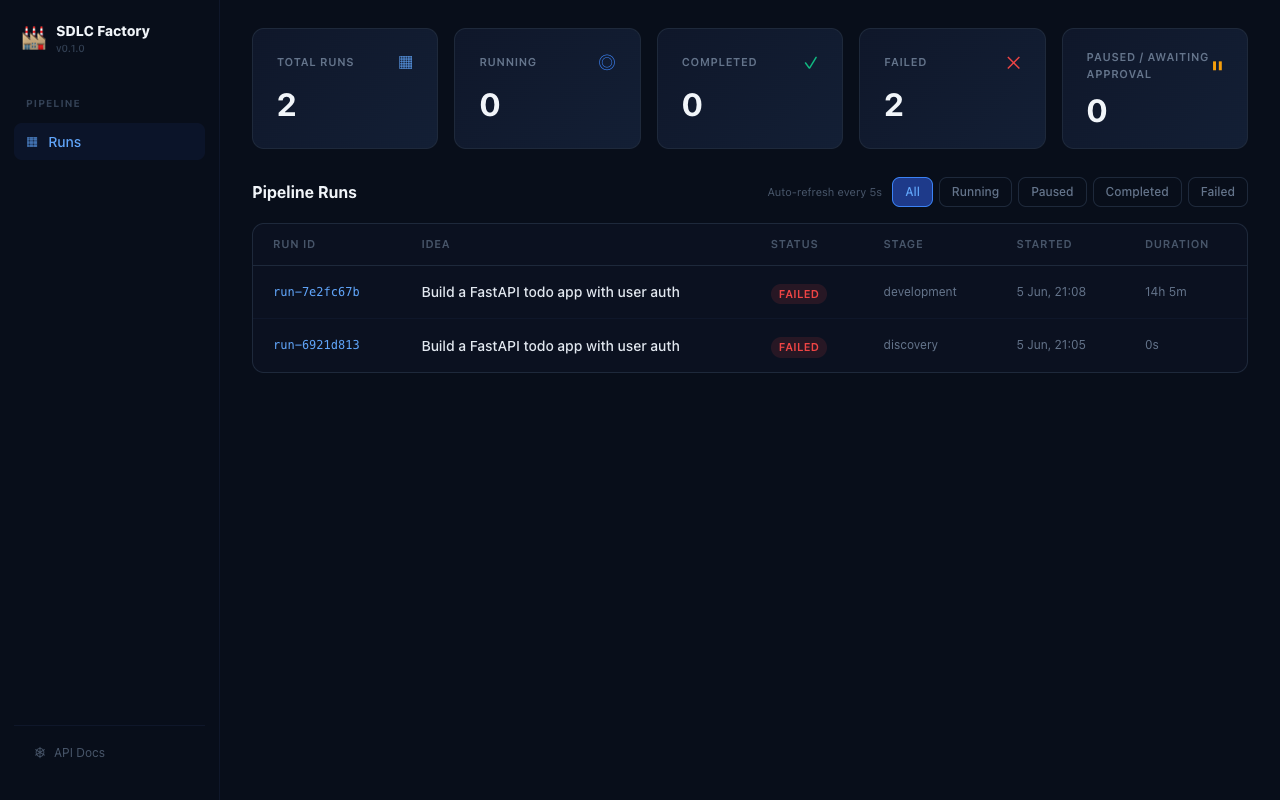
The dashboard shows all runs with their current stage, status badge (Running / Completed / Failed / Paused), start time, and duration. The stat cards at the top give a live count across all states so you can see at a glance what’s in-flight.
Clicking a run opens the run detail view, a stage pipeline with clickable nodes, each revealing its artifact, kanban tasks, audit trail, and cost breakdown in tabbed panels.
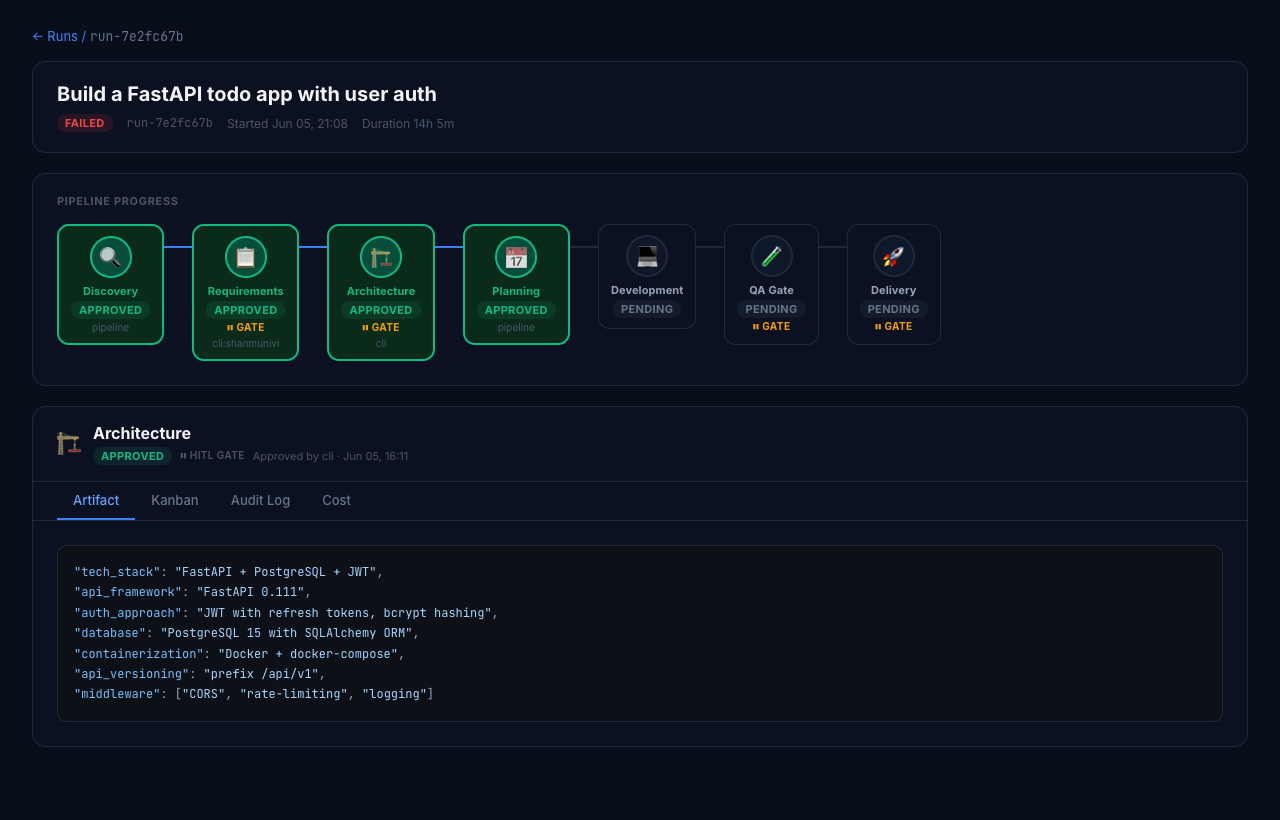
The pipeline progress bar shows all 7 stages. Stages with HITL gates are marked with a ⏸ GATE label. Approved stages show who signed off (pipeline auto-approve vs. human operator) and the timestamp. The Architecture stage here was reviewed and approved via CLI with the rationale recorded.
HITL Audit Log
Every gate decision, Approved, Rejected, or Amended, is timestamped and stored. The audit log view shows the full decision history for a run:
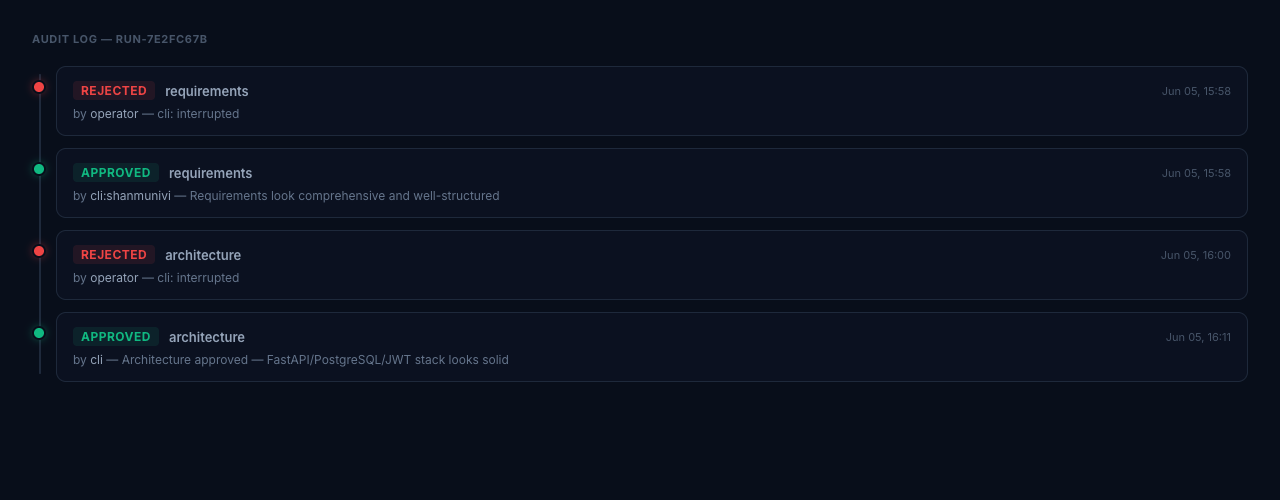
Rejections with cli: interrupted are operator-side ctrl+C interrupts before the gate prompt completed, the pipeline pauses and re-presents the gate on the next resume. Human approvals carry the actor name and rationale string verbatim.
Kanban Blackboard
During the parallel development stage, each developer agent claims tasks from a shared kanban board backed by SQLite. The board live-updates as agents progress:
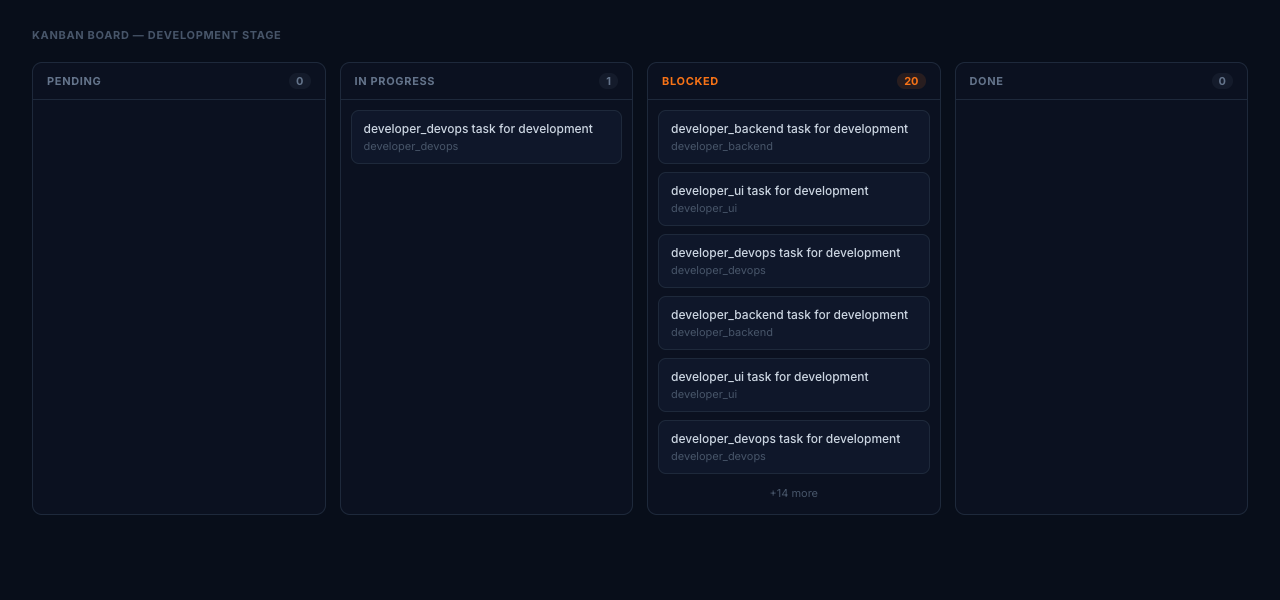
The 20 blocked tasks here reflect a provider API error (tool_results role mismatch) that stopped the development agents mid-iteration, exactly the kind of failure the checkpoint/resume system is designed to recover from.
Token Usage and Cost
Every agent turn records tokens in, tokens out, model used, and duration. The cost tab breaks this down by stage and role:
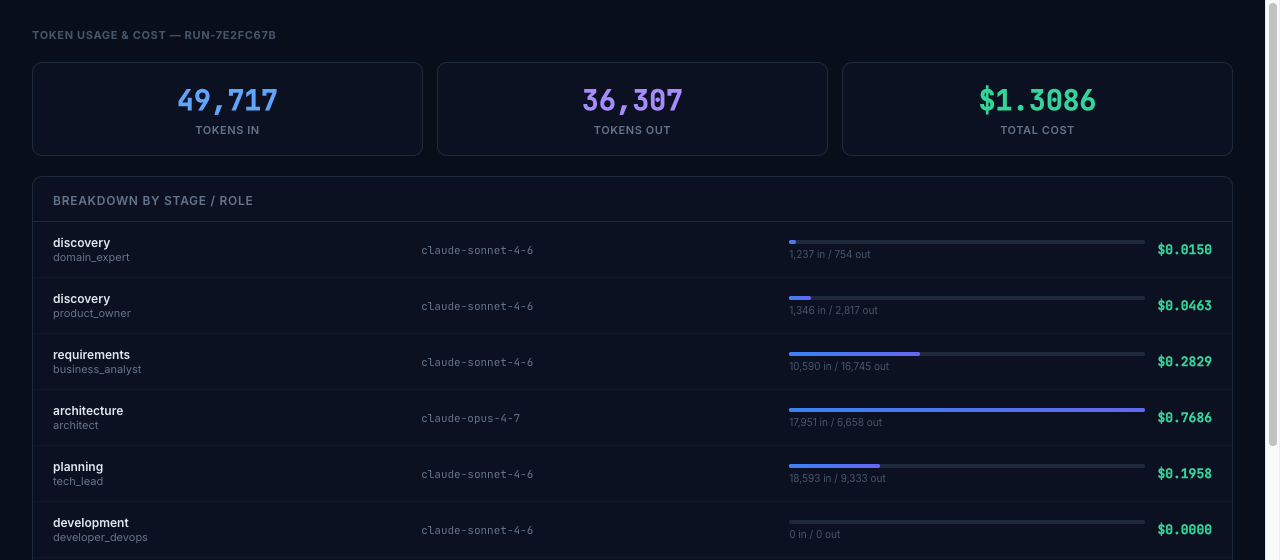
Architecture is the most expensive stage ($0.77) because it uses Claude Opus with a large context window loading all prior discovery and requirements artifacts. The Business Analyst (requirements) comes second at $0.28 for the longest wall-clock run (~10 minutes). Development registers $0 here because the agents failed before making any API calls, cost tracking is per-turn so partially-completed agent runs are fully accounted for.
What I Got Wrong (And Fixed)
Shared filesystem for parallel developers. Three agents writing to the same directory clobbered each other’s files within seconds. Fix: path-scoped namespacing, each developer owns output/<run_id>/src/<task_id>/ exclusively, with path traversal validation on every write.
Too much context injected too early. Early versions injected all prior stage artifacts into every agent. The Architect was seeing the Product Owner’s raw conversation. Context budgets burned on noise, agents hallucinated based on conversational artefacts rather than structured ones. Fix: the prior_stages() declaration, each agent gets only what it needs, as validated JSON.
No iteration budget. Without a turn limit, agents on ambiguous tasks would loop indefinitely, rewriting the same file, retrying the same tool call, asking clarifying questions to themselves. Fix: IterationBudget with role-appropriate defaults (50 turns for Architect, 30 for developers, 20 for others).
Sync SQLite under concurrent threads. Without WAL mode and retry logic, concurrent developer threads deadlocked on DB writes constantly. Fix: WAL mode at connection open, jittered exponential backoff on OperationalError.
No AMENDED path in HITL. Early gates had only APPROVED and REJECTED. Rejection meant restarting from scratch, far too heavy for “I want to tweak this one ADR.” Adding the AMENDED path required rebuilding the gate interface but it’s the feature that made the system practical.
Checkpoint and Resume
Every completed stage writes artifacts to both SQLite and disk:
output/<run_id>/
  artifacts/
    discovery.json
    requirements.json
    architecture.json
    ...
  src/
    backend/
    ui/
    devops/
On crash or manual pause, sdlc resume <run_id> reloads all completed artifacts from SQLite and starts from the first non-completed stage. No data loss, no regeneration cost for finished work.
Closing thoughts
Building this changed how I think about agentic systems. My first instinct was to give the agents as much freedom as possible: let them spawn sub-agents, share context and work out coordination themselves. For a reliable pipeline, the opposite worked better. Tight contracts, scoped context, enforced schemas and explicit coordination.
Most of the complexity isn’t in the agents. It’s in the glue: the memory tiers, the artifact contracts, the HITL gateway, the QA loop and the context compressor. Each one exists because of a specific failure in an earlier version. None of it is glamorous, and all of it is needed.
If you’re building agents for production, start with the handoffs rather than the agents. The agents themselves are the easier part.
The full codebase is at github.com/shanmuga-sundaram-n/sdlc-factory. Questions and contributions welcome.